

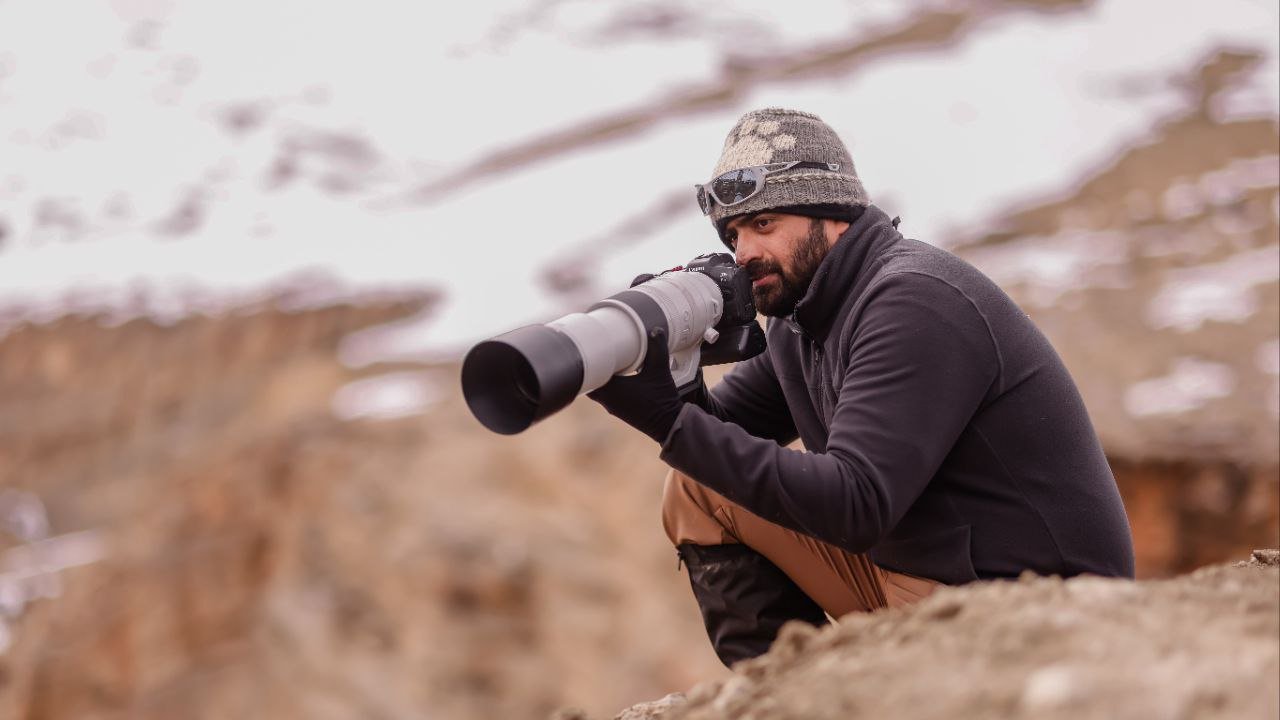

This film is from my first trip to the Himalayas — a winter expedition to Spiti in 2025. I went there looking for the snow leopard. But even in the coldest months, this high-altitude desert has far more life than I imagined. This winter wildlife documentary features the highlights of our trip - snow leopard, red fox, Himalayan ibex, blue sheep and Himalayan wolves. We started our days around sunrise, scanning cliffs for movement. One morning, we heard of a horse carcass near Langza and watched a red fox stash pieces of meat in the snow — behaviour that helps it survive long winters. We then saw feral dogs appear, and got a sense of the conflict between wildlife and dogs. We photographed large herds of Himalayan ibex moving across steep rocky slopes. We saw large male herds — different horn classes together — waiting for their chance to climb up. We photographed blue sheep grazing on high slopes through the day, sometimes scraping at the snow with their hooves to reach buried vegetation. And on one of the coldest afternoons of the trip, we saw two Himalayan wolves — tiny silhouettes in the wind, but enough to understand how elusive they are. We did see a snow leopard too — hidden on a cliff, perfectly camouflaged. A reminder that in these mountains, patience matters.

This video features one of the rarest wildlife sightings I've come across - snow leopards in courtship, mating, fights and their struggle for survival, all caught on camera at Kibber, Spiti. In March 2025, I visited Spiti Valley, a high-altitude cold desert in Himachal Pradesh, India, with a single goal: to see the rare and endangered snow leopard in its natural habitat. The Spiti Valley, carved by the Spiti river and bordered by Tibet, is a place of stark beauty and ancient geology. Its deep gorges, sedimentary rocks, and snow-covered peaks are home not only to snow leopards but also to blue sheep (bharal), ibex, red foxes, Tibetan wolves, lammergeiers, and golden eagles. These species have evolved remarkable adaptations to survive at altitudes above 4,000 meters, where temperatures can plunge to minus 20°C and oxygen is scarce. Our journey began in Shimla, climbing steadily through Kalpa, Kaza, and finally to Kibber, our base camp perched at 4,200 meters. Acclimatization was a challenge-every step at this altitude was a reminder of the thin air and the physical demands of high-altitude wildlife tracking. Even before reaching our hotel in Kaza, we received word of a snow leopard sighting at Shego. Instead of checking in, we made a detour straight to the site. Most wildlife enthusiasts spend days or even weeks in the mountains without a single glimpse of a snow leopard, but our luck was extraordinary. The snow leopard, perfectly camouflaged against the snowy cliffs, appeared briefly-a living phantom-before vanishing into the rocks. This first sighting set the tone for what would become an unforgettable expedition. The next morning, our plans for a leisurely breakfast were interrupted by another sighting, this time in the village of Langza. In Spiti, a snow leopard sighting is a community event. Villagers, spotters, wildlife photographers, and tourists gather in the biting cold, setting up tripods, spotting scopes, and even chairs to peer into the distant rock faces. Hot beverages and packed lunches are shared as everyone waits for a glimpse of the elusive cat Spotting a snow leopard is never easy. Their grey coats, patterned with black rosettes, blend seamlessly into the rocky landscape. Even with a powerful telephoto lens, it took the expert guidance of our local spotter, Sonam, to finally bring a mating pair into focus. The male, his face bloodied from a recent fight, stood over the female. On a distant ledge, a third snow leopard-an older male, presumably defeated in the territorial battle-licked his wounds. To see three snow leopards in one frame is a privilege few ever experience Once they were up, we saw some rare courtship behaviour, with the female gently nudging the male and adopting the classic mammalian lordosis posture. Their mating, repeated multiple times in the same rocky alcove, was both intimate and intense-a rare wildlife moment rarely captured on camera. Meanwhile, the injured older male kept his distance, retreating to a cave after a brief standoff with the younger rival. After the adrenaline of our first two days, the pace of wildlife watching slowed. On day three, the snow leopards did little more than sleep on distant ledges, blending into the rocks as we waited for hours in the cold. In these quiet moments, the valley revealed its other treasures: herds of blue sheep navigating impossible slopes, lammergeiers soaring overhead, and calls of Himalayan birds echoing through the gorges. Wildlife photography in Spiti is as much about patience and observation as it is about action. The slow rhythm allows for reflection-on the interconnectedness of species, the fragility of this ecosystem, and the privilege of witnessing life at the edge of survival. The story is also about the people-the spotters, guides, porters, and villagers-who make such encounters possible. Their knowledge, hospitality, and commitment to conservation are as inspiring as the wildlife itself.
